
Dreams and Desperation: Ernest Hemingway’s Family in Pinellas County, Florida
Please note this article was first published in The Florida Genealogist, Volume XLVIII – Number 1 (161), June 2025
By Karen A. Fortin
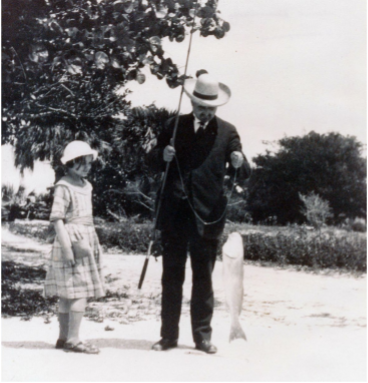
Clarence Hemingway with daughter Carol on Sanibel Island, April 1921 (Courtesy of the Sanibel Historical Museum and Village, Inc.)
When we think of the words Hemingway and Florida, we automatically picture the iconic estate of Ernest Hemingway in Key West. However, Ernest was not the first member of the Hemingway family to regularly visit the state. From at least 1909, his paternal grandparents, Anson and Adelaide (Edmonds) Hemingway, began winter visits to picturesque Sanibel Island, just off the coast from Fort Myers in Lee County.[1]
In April 1921, Ernest’s father, Clarence Edmonds Hemingway, and Ernest’s youngest sister, Carol, joined Anson, Adelaide, and Clarence’s sister Grace on Sanibel Island for a brief escape from the snow in Oak Park, Illinois.[2] Clarence, an avid fisherman and outdoorsman, must have greatly enjoyed his trip to Florida as he and his wife, Grace Hall Hemingway, began their own winter excursions beginning in 1923. However, unlike Ernest’s grandparents, his parents preferred the more populous and urbanized area of Pinellas County.[3]
For better or for worse, Clarence and Grace’s early visits coincided with the start of Florida’s brief land boom in the 1920s, when hopes of making a fortune on land speculation, particularly on the buying and selling of lots in newly created subdivisions, brought on a gold fever-like atmosphere that encouraged locals and winter visitors alike to invest their life savings in the seemingly endless possibilities promoted by a horde of agents eager to take their money.[4]
Although Clarence was a practicing family doctor, he was no stranger to real estate. Both his father, Anson, and his brother George were successful real estate agents, and his wife’s cousin, Fred E. Hall, had made money selling Florida property.[5] Clarence must have thought he would be able to follow in his family’s footsteps and make enough money to set himself and his family up for the future. From 1924 to 1927, Clarence purchased 17 subdivision lots in St. Petersburg, Clearwater, and Gulfport.[6] Clarence was able to do this by investing the entirety of his and Grace’s savings, the money he had inherited following his father’s death in 1926, and a $15,000 mortgage he took out on the family home in Oak Park.[7] In other words, he gambled everything he had or could borrow on what he thought was a once-in-a-lifetime opportunity.
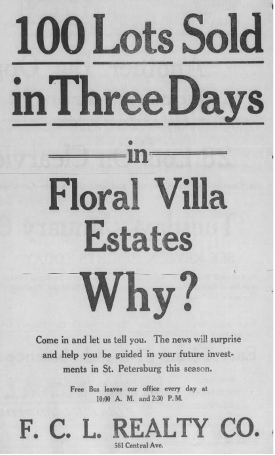
Real estate advertisement in St. Petersburg Times newspaper, 4 January 1925, p. 10
Unfortunately for Clarence, even as he was purchasing his last Florida properties, the boom had already gone bust.[8] As with hundreds of other hopefuls, Clarence was left holding empty lots in barely developed subdivisions that no one wanted to live in, in debt, and trying to figure out how he was going to pay off the mortgage payments back home and the inevitable taxes on now nearly worthless property. His dreams of being able to retire to Pinellas County with his wife and live a comfortable life in the sunshine were dashed.
Clarence was able to sell at least one of his Florida properties in November 1926 for $1,120 to be paid to Clarence and Grace in three payments over 18 months.[9] His last trip to Pinellas County took place in the spring of 1928, when he and his wife rented rooms on 3rd Avenue NE in St. Petersburg, a short walk from the recently opened “Million Dollar Pier.”[10] A real estate advisor reassured Clarence and Grace that it was only a temporary lull, and the value of their properties would rebound soon, so the Hemingways held on to the remaining lots in the hope that this advice would prove true.[11]
Marcelline Hemingway Sanford, Ernest’s oldest sister, portrays her father’s desperation after he sank everything into his Florida dream and was then faced with the consequences of his actions. Accounts from Marcelline and others portray Clarence as a man who had long struggled with worsening mental health issues. He was known to have unpredictable and sudden mood shifts from his usual affability to anger that became increasingly frequent over time. By 1927 and 1928, Clarence became suspicious of nearly everyone and began locking his bureau drawer and his clothes closet and regularly locking himself in his office at home.[12]
In addition to his mental struggles, his physical health had also taken a turn for the worse. By 1928, Clarence had been diagnosed with both diabetes and angina pectoris. Marcelline recounts that her father’s hair had begun to turn silver in 1926, when he was only 55 years old, and he began looking thinner and more tired.[13] It seems likely that his health issues and the reality that he may not be able to continue with his medical practice for many more years, at least in part prompted Clarence’s plunge into the Florida real estate market in the hope of ensuring that he and his family would be taken care of in the future.
In Marcelline’s book, At the Hemingways: A Family Portrait, she describes a conversation between her father and her uncle, George Hemingway. As December 1928 approached and the looming date for the next round of payments on the Florida properties were imminent, Clarence sought help from his brother. Rather than help him financially as Clarence had hoped, George advised him to sell off as much of the land as he could. Clarence responded, “But I don’t see how I can sell those lots. They are for our family and our future.”[14]
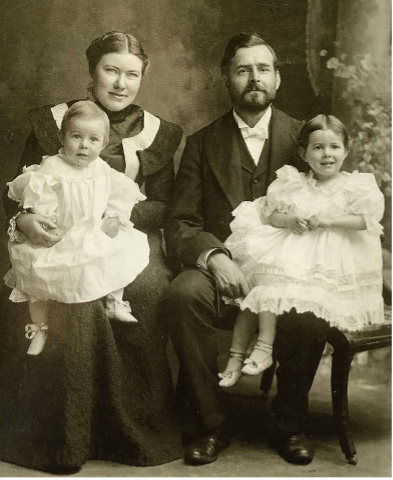
Grace Hall and Clarence E. Hemingway with Ernest (left) and sister Marcelline (right), 1900 (EHFOP Archives)
The stress and financial worries took a severe toll on Clarence’s physical and mental health. After he returned from Florida to Oak Park with Grace in 1928, he refused to slow down his medical practice or follow the health guidelines he knew all too well for treating his diabetes.[15] His conversation with George appears to have been a last-ditch effort to try and alleviate some of the pressure building within him. It failed.
On the morning of December 6, 1928, Clarence woke up with pain in one of his feet. When he mentioned this to Grace at breakfast, she insisted that he visit the hospital to have it checked out. Clarence told her that he would do so and then left the house for his usual morning rounds. He returned around noon and said that he was going to rest for a while and asked Grace to let him know when lunch was ready. He proceeded upstairs to his bedroom, closed the door, picked up his father’s Civil War pistol, and shot himself.[16]
Marcelline’s recounting of her father’s last few years portrays Clarence’s growing desperation. Following his diagnosis of diabetes in 1927, Clarence stated, “But I’ve never been sick. I can’t live that way…I won’t be an invalid.”[17] Marcelline believed that her father either knew, suspected, or feared that the foot pain meant the development of gangrene. He had previously treated a patient who had lost a leg that way. The thought of possibly finding himself in a similar situation and the constant pain from his heart problems, combined with the likely inability to think clearly as his mental health deteriorated, brought about his suicide as an effort to, as Marcelline put it, “solve all his problems.”[18]
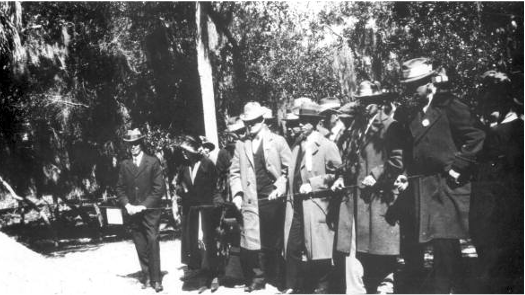
People watching Smithsonian excavation of Indian Mound at Weedon Island, ca. 1924 [Florida Memory – public domain]
Of course, Clarence’s actions only made the situation worse for the family he left behind. In addition to the mortgage payments and the taxes owed in both Illinois and Florida, Clarence’s life insurance policy was only partially paid out due to a suicide clause.[19] Ernest stepped in to help his mother and the youngest siblings still at home and Grace began to take in boarders at the house in Oak Park.[20] Over the years, until her death in 1951, Grace made repeated trips to Pinellas County and managed to sell off all but three pieces of property.[21] It appears that she continued to struggle during this time to keep up with the recurrent taxes as shown by a public auction notice published in St. Petersburg Times on May 10, 1950, listing properties that would be put up for sale for failure to pay takes.[22] Grace H. Hemingway is listed as the owner of Lot 4, Block 10, in the Florida Riviera Plat No. 2 subdivision. This lot was purchased by the couple on June 24, 1926.[23] The amount of taxes owed was only $1.18.
Ernest himself may have visited Pinellas County at least once as suggested in a letter dated February 20, 1929, from Ernest to his mother. He states that he, “will be down in Florida in a year or two again and like Dad the taxes will give me a good excuse to go to St. Petersburg.”[24]
Of the three lots left following Grace’s death, Lots 7 and 8 of Block 6 in the Center Section of the Shore Acres subdivision of St. Petersburg were left to Ernest. He continued to own the undeveloped lots until his own death by suicide on July 2, 1961. Ernest’s probate documents show that the lots were worth $1,800 at that time.[25] His last wife, Mary Welsh Hemingway, finally sold them to a Florida builder for $8,000 on October 23, 1978.[26]
A final, disturbing note related to the Hemingway family’s connection to Pinellas County is seen in an incident that took place during Clarence’s last trip to Florida. Weedon Island is located just off the Tampa Bay side of St. Petersburg. Today this is the home of Weedon Island Preserve, a 3,190-acre natural area that includes the cultural remains of Native Americans who lived in the region for thousands of years. In March 1928, Clarence visited Weedon Island and dug in at least one Indian mound, removing the skeletal remains of two Native American individuals; a male between the ages of 25 and 40, and a female between the ages of 30 and 60.[27]
These remains were later boxed up and sent to a museum in Maine where they eventually became part of the stored collection at the Hudson Museum at the University of Maine. In 2015, the Hudson Museum reached out to the National Park Service to notify them of the remains found in their collection. An anthropologist had examined them and determined that they were of Native American origin and, therefore, fell under the Native American Graves Protection and Repatriation Act of 1990. The museum documentation identified the individuals as being from the Calusa Tribe.[28] Although the Calusa Tribe disappeared from Florida in the 18th century, the National Park Service’s notice of the investigation identified the Miccosukee Tribe and the Seminole Tribe as the “present-day Indian tribes with a shared group identify to these remains.” Although documentation was not found online, it is almost certain that the remains were returned to one or both tribes following the 2015 investigation.
The most likely connection between Clarence Hemingway and Weedon Island is through the land developer for the Florida Riviera subdivision mentioned above. This developer, Eugene M. Elliott, was a colorful and well-known character during the 1920s Pinellas County land boom. He purchased Weedon Island in 1923 and began the Boulevard Bay Land Development Company, planning to subdivide the island into lots. To gain publicity to the area, Elliott lured archaeologists from the Smithsonian Institution to the Weedon Island’s Indian mounds. Although the archaeologists could tell that the artifacts they were taken to were planted, or “salted,” in one of the mounds, the stunt was ultimately successful and formal excavations began, headed by Jesse Walter Fewkes. His team reportedly removed over 400 skeletons and various artifacts from the mounds by 1924. During the ongoing excavations, Elliott would bring prospective property buyers to Weedon Island to watch the work being conducted.[29] This is undoubtedly how Clarence learned of the mounds.
In March of 1928, when Clarence decided to try his own hand at digging,[30] Elliott had already gone bankrupt following the end of the land boom and Weedon Island was vacant and in foreclosure.[31] Marcelline’s narrative of the Hemingway family states that, as a boy, Clarence “often spent his free hours after school delving into old Indian mounds along the Des Plaines River.”[32] At a time when his health was failing and he was consumed with financial worries, he may have wished to engage in an activity that reminded him of a more carefree time in his life. He, like so many others of his era, casually dismissed the Native American remains that he unearthed as little more than curiosities and “relicts.”[33]
I’d like to thank Carla Mayer of the Ernest Hemingway Birthplace Museum in Oak Park, Illinois, for bringing this topic to my attention and providing invaluable help in its research.
[1] John Sanford, “A Garden of Eden, or, Hemingway’s Last Lot,” North Dakota Quarterly, 66, 2 (Spring 1999): 159-163.
[2] Ernest Hemingway to Clarence Hemingway, 15 April 1921; Ernest Hemingway, Ernest Hemingway Selected Letters, 1917-1961, Carlos Baker, editor (New York: Scribner, 1981), 45-46.
[3] “Local and Personals,” St. Petersburg Times [Florida], 28 October 1925, page 4, column 2; imaged, Newspapers.com (https://www.newspapers.com/image/314638373: accessed 26 January 2025).
[4] Willie Drye, For Sale—American Paradise: How Our Nation Was Sold an Impossible Dream in Florida (Guildford, Connecticut: Lyons Pres, 2016), 81.
[5] Marcelline Hemingway Sanford, At the Hemingways: A Family Portrait (Boston: Little Brown, 1962), 224; imaged, HathiTrust (https://catalog.hathitrust.org/Record/000437559: accessed 5 March 2025).
[6] Sanford, “A Garden of Eden,” 161. (I was able to confirm 16 of these purchases in the microfilmed records held at the Pinellas County Clerk of the Circuit Court Clearwater Courthouse offices, 315 Court St., Clearwater, FL 33756; accessed 5 February 2025 and 26 February 2025.)
[7] Ernest Hemingway to Maxwell Perkins, 9 December 1928; Ernest Hemingway, The Letters of Ernest Hemingway, Volume 3: 1926-1929 (New York: Cambridge University Press, 2015), 479-480.
[8] Christopher Knowlton, Bubble in the Sun: The Florida Boom of the 1920s and How it Brought on the Great Depression (New York: Simon & Schuster, 2020), 220.
[9] Pinellas County, Florida, Mortgage Deeds, Volume 335, page 187, Clarence E. Hemingway and Grace Hall Hemingway to Thomas H. Kingston, John S. Wells, William G. Gibson, and Evan H. Jones, 2 November 1926; microfm, Pinellas County Clerk of Circuit Court Clearwater Courthouse Office.
[10] “Dr. C. E. Hemingway Dies in Illinois,” St. Petersburg Times [Florida], 15 October 1929, page 7, column 3; imaged, Newspapers.com (https://www.newspapers.com/image/315291183: accessed 8 February 2025).
[11] Sanford, At the Hemingways, 227.
[12] Ibid., 229.
[13] Ibid., 224.
[14] Ibid., 230.
[15] Ibid., 229.
[16] Ibid., 230-232; Mary V. Dearborn, Ernest Hemingway: A Biography (New York: Alfred A. Knopf, 2017), 267.
[17] Ibid., 226.
[18] Ibid., 232.
[19] Ibid., 235.
[20] Ernest Hemingway, The Letters of Ernest Hemingway, Volume 3: 1926-1929 (New York: Cambridge University Press, 2015), Footnote #2, 557.
[21] Sanford, “A Garden of Eden,” 162.
[22] Pinellas County Tax Collector notice, St. Petersburg Times [Florida], 10 May 1950, page 43, column 2; imaged, Newspapers.com (https://www.newspapers.com/image/314969111: accessed 8 February 2025).
[23] Pinellas County, Florida, Deeds, Volume 450, page 521, Boulevard and Bay Land Development Company to Clarence E. Hemingway, Married, 24 June 1926; microfilm, Pinellas County Clerk of Circuit Court Clearwater Courthouse Office.
[24] Ernest Hemingway to Grace Hall Hemingway, 20 February 1929; Ernest Hemingway, The Letters of Ernest Hemingway, Volume 3: 1926-1929 (New York: Cambridge University Press, 2015), 534.
[25] Monroe County, Florida, Report of Appraisers, Estate of Ernest Miller Hemingway; Pinellas County (Florida) Clerk of Circuit Court, Book 4768, page 819, 27 October 1978; imaged, Clerk of the Circuit Court and Comptroller, Pinellas County, Florida, Official Records Search (https://officialrecords.mypinellasclerk.gov/: accessed 27 January 1925).
[26] Sanford, “A Garden of Eden,” 162.
[27] “Notice of Inventory Completion: Hudson Museum, University of Maine, Orono, ME,” Federal Register, Vol. 80, No. 221, 17 November 2015, page 71840-71841 [2015-29357]; imaged, Justia (https://regulations.justia.com/regulations/fedreg/2015/11/17/2015-29357.html: 5 March 2025).
[28] Nok-Noi Ricker, “UM Museum Seeks to Return Hemingway Bones to Florida Tribes,” Bangor Daily News [Maine], 21 November 2015; accessed online through Bangor Daily News website archive, 26 January 2025, sent via email to me from Carla Mayer, volunteer, Ernest Hemingway Birthplace Museum, Oak Park, Illinois.
[29] Pinellas County Department of Environmental Management, Environmental Lands Division, “The Weedon Island Story,” Third edition, April 2005; imaged, Weedon Island Preserve website (https://www.weedonislandpreserve.org/pdf/WIBookWeb.pdf: accessed 8 February 2025), p. 25, 29. (A note sent with the remains mailed to the museum in Maine, noted in the article from the previous citation, stated that over 1,300 skeletons were removed by the Smithsonian Institution team by 1930.]
[30] Riker, “UM Museum Seeks to Return.” (The month of Clarence’s excavation on Weedon Island was on the note sent with the remains to the museum in Maine.)
[31] Pinellas County Department of Environmental Management, “The Weedon Island Story,” 30.
[32] Sanford, At the Hemingways, 21.
[33] Riker, “UM Museum Seeks to Return.” )The phrase “my relicts” was included on the note with the remains.)