
Hemingway as Journalist: the Oak Park/Kansas City Connection
By Steve Paul
As he fished for trout and cut hay up in Michigan over the summer of 1917, Ernest Hemingway had no clear picture of his future.
He’d just graduated from Oak Park High School, and college was not yet an option. Maybe next year he’d go off to the University of Illinois. But for now, he was considering alternatives.
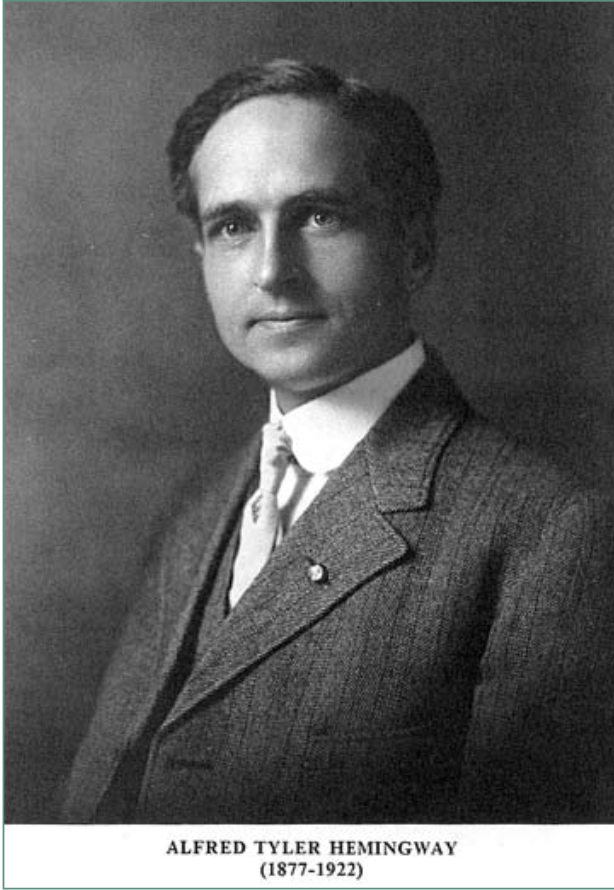
In letters he mentions going off to stay with an uncle (his mother’s brother Leicester) in California, or maybe landing a job at the Chicago Tribune, where Ring Lardner’s byline appeared. By early August his uncle in Kansas City, Alfred Tyler Hemingway, dangled another idea while visiting the family at Walloon Lake.
Uncle Tyler, Clarence Hemingway’s youngest brother, had gone to Oberlin with an editor of The Kansas City Star, and he suggested that Ernest come down and get a job as a newspaper man.
Ernest had read Richard Harding Davis, who had glamorized the newspapering life. He had written for the high school paper. And a family friend, Trumbull White, had told Ernest that the way to learn how to write was by writing.
But Kansas City was not such a sure thing. Hemingway apparently was not much fond of his uncle, and for some reason he couldn’t commit. For weeks.
Earlier in the summer, while hanging out with Bill Smith and his sister, Kate, Ernest had met their friend, Carl Edgar. Carl, nearly 10 years older than Ernest, worked for a fuel oil company in Kansas City. It’s likely that Ernest thought Carl would present an opportunity to escape much contact with his Kansas City relatives.
Still, as late as the last week of September, Hemingway was holding out hope of landing a newspaper job in Chicago. His English teacher at Oak Park, Fannie Biggs, had written on his behalf to the managing editors of the Tribune and the Examiner. But neither paper was hiring. Hemingway was still in Michigan, picking apples and pulling potatoes from the dry brown earth, when he got the news.
Yet Ernest got encouragement from other quarters:
“(Y)ou know you are much better fitted to be a newspaper man than anything else,” an Oak Park friend, Lucille Dick, wrote to him in early October. “Your writing is so clever—so easy and so really fine that it would be a crime for you not to make the most of your talents.”
The Chicago newspaper world’s loss, it turned out, was Kansas City’s gain. On the morning of October 15, Dr. Clarence Hemingway stood on the station platform as his oldest son, with a mixture of fear and embarrassment (according to Hemingway’s fictionalized account), boarded the train bound for Kansas City.
By the evening, as Ernest settled into his uncle’s fine Victorian home, he would have been able to savor the top story in the 5 p.m. edition of The Kansas City Star: “Sox Win the Title,” the bold headline read. Beneath it came the box score and a running account of the sixth game of the World Series. Chicago’s White Sox had beaten the New York Giants, 4-2 that day and four games to two in the series.
Tyler Hemingway worked for a lumber company and was a businessman through and through. Ernest’s exasperating relationship with his parents extended to his uncle. Evidence for that comes from Carl Edgar, who once noted that Ernest thought Uncle Tyler to be “a vain, pompous man absorbed in his own grandeur and wholly lacking in a sense of humor.”
Tyler was married to his boss’s daughter, the former Arabell White. Her father, John Barber White, was a prominent citizen and known nationally for his work as a conservationist and his political connections. Often identified as a millionaire lumberman, White and his family lived in a mansion just a few blocks from the Hemingways. Not long before Ernest arrived in Kansas City, White’s company acquired 103,000 acres of virgin pine forest in Louisiana from the heirs of Jay Gould.
How much of his grand-uncle’s life and influence Hemingway learned during his six and a half month stint in Kansas City is unclear. White was among those who wrote letters of recommendation in early 1918 when Hemingway applied to join the Red Cross ambulance service in Italy. Though he was not close to Tyler and Arabell, Hemingway did develop a friendship with White family cousins, which lasted well into the 1930s.
After the war, Uncle Tyler encouraged Hemingway to write an account of his experience in Italy. In fact his brother-in-law, John B. White, was a leader of the Missouri Valley Historical Society and a promoter of the effort to build a World War I memorial in Kansas City. “Do not forget that the Historical Society expects from you some sort of a statement,” Tyler told him, “...which I know you can write in a very attractive way.”
If Hemingway responded to his uncle, the letter, and his surely attractive statement, has not been found.
Steve Paul worked for the Kansas City Star for 40 years, as a reporter, writer, and editor. He is the author of two books, including Hemingway at Eighteen: The Pivotal Year That Launched an American Legend. He lives in Kansas City, Missouri.
This article was published in the Hemingway Foundation Spring/Summer Dispatch 2007