
By Craig Mindrum, Ph.D.
In my earlier blog-review of Scott Schwar’s book, My Journey with Hemingway, I briefly touched on the work of the Ernest Hemingway Foundation of Oak Park (EHFOP) in which Schwar played a critical role. (Full disclosure: I am a current Board member of the Foundation.) In the blog, I credited the Foundation with helping to put Oak Park on the map as a hub of Hemingway scholarship, conferences, and other activities. In this blog I’m going to do a bit of a deep dive into the work of the Foundation.
The Foundation was formed in 1983 by Morris Buske, then a teacher at Oak Park-River Forest High School. Along the way, Buske also became an amateur historian, publishing a book about Ernest’s early life as a student.
Oak Park at the time was mostly overlooked as an influence on Hemingway. In a quote that was probably never uttered, Hemingway supposedly described the village as having “broad lawns and narrow minds.” The phrase stuck in people’s heads for a good long time. The Foundation set out to correct that misconception.
From early on, the Foundation expressed interest in Hemingway’s childhood home at 600 N. Kenilworth, in which the family lived from about 1906-1936. The Foundation considered options such as a museum on the site and a tour business. Use of the house (except for occasional tours) did not fully come to pass, as attention eventually turned to Hemingway’s birthplace home at 339 North Oak Park Avenue.
The work of the Foundation board began with plans for an annual Hemingway birthday celebration beginning on July 21,1984. Screenings of movies and dramatizations based on Hemingway’s books were part of the observance, which concluded with a dinner celebration at a local hotel. The birthday celebration continued as a tradition through the years (up to the present day), with plans that became ever more elaborate.
The Foundation began concentrating on its ties with the Hemingway scholarly community, inviting scholars to come and deliver an address at the time of the birthday celebration. An important event was a Hemingway Film Festival, held in 1987. Another major occurrence was a “Bastille Day” street party that July. This began a long tradition of celebrations around Hemingway birthday activities each year.
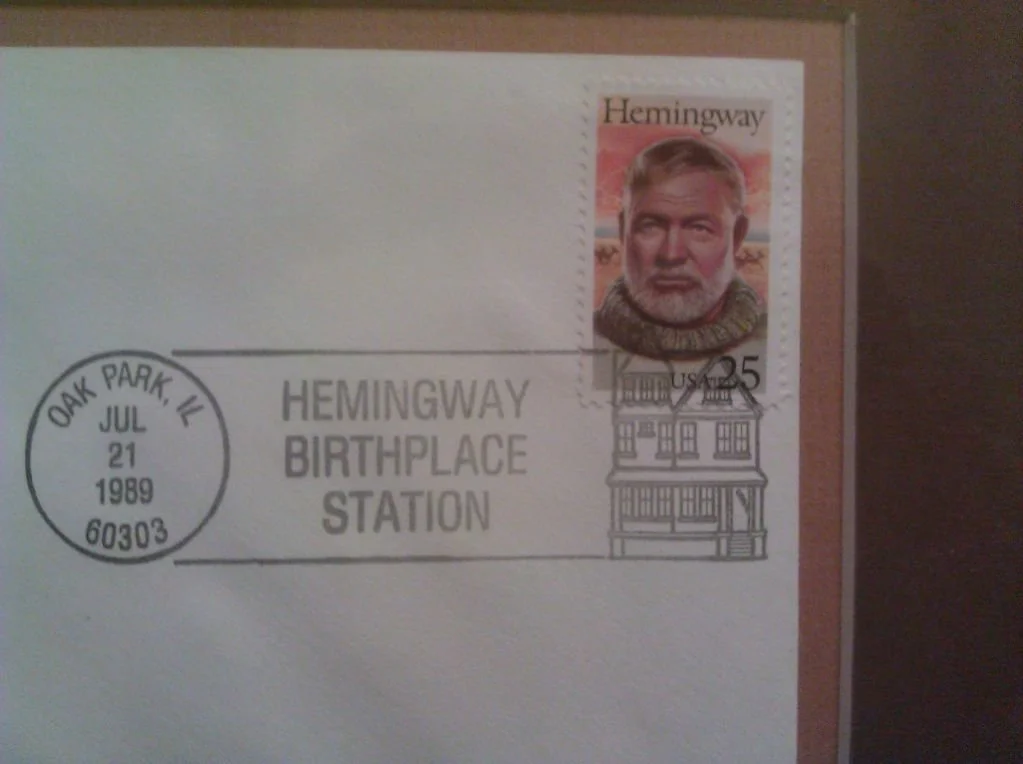
Hemingway Stamp
The US post office planned a new stamp to be released near Hemingway’s 90th birthday in 1989. Initially snubbed as a place of issue in favor of Key West, the Foundation lobbied hard to have Oak Park included. “This,” writes Schwar, “was Oak Park’s opportunity to break out onto the national stage as a major Hemingway player.”
After intense lobbying including letter-writing and some arm twisting by Illinois politicians, the USPS broke tradition and awarded Oak Park an equal first-day issue stamp a few days later, on Hemingway’s actual birthday.
Hemingway Museum
In 1989, Schwar wrote a research paper, “Developing an Ernest Hemingway Museum in Oak Park.” This became the seed from which a new museum arose. The idea was to create a base exhibit of Hemingway’s early and formative years that could be expanded on. The Foundation received several important collections along the way. The museum established itself in 1991 on the first floor of a recently acquired former church in Oak Park. The location also provided space for lectures, fundraising events, and other activities. The museum was operational until 2017, and many artifacts made their way eventually to the Hemingway birthplace home.
Fiesta de Hemingway
Building on the success of the Bastille Day Hemingway birthday celebrations, the Foundation expanded the idea and refashioned it as an annual Spanish-themed fiesta. The celebration was quite extensive. A Chicago Tribune article summarized it well. The festival
dedicates the birthplace home of the village's most famous author Ernest Hemingway. This year's festival, which again offers everything from a Hemingway look-alike contest to a 94th birthday party, is expected to draw between 15,000 and 20,000 participants. Friday's running of the (mechanical) bulls in mock celebration of the [Pamplona] festival featured in Hemingway's The Sun Also Rises, sets the tone for a two-day series of street parties, children's theater, games, performance poetry, a book fair, and other entertainment.
All proceeds from the events benefit the foundation…. For all its frivolity, the fundraising Fiesta is a serious attempt to solidify the village's effort to become the geographical hub of Hemingway scholarship.
Hemingway Birthplace Home
In 1991, the Oak Park Development Corporation was working to bring managed tourism to Oak Park. Through earlier connections with the owner of the Hemingway birthplace home, the Foundation was authorized to place an offer on the house, which they eventually purchased. With the help of some state politicians, plans moved forward for fundraising and building plans. In December 1996, a $550,000 birthplace historic restoration plan was submitted. Schwar offers extensive discussion of the ups and downs of refurbishing the old home. In November 2001, a Restoration Celebration weekend was held to mark the completion of the home project.
Chapter 8 of the book details all the activities undertaken by the Foundation from the early 1990s onward. These included travel, lecture series, sister city initiatives, an International Oak Park International Hemingway Conference (held in 1993) and many other activities. As I wrote in my previous blog, Schwar must have taken copious notes and kept a diary through the years, because of the detail he provides. Future historians will benefit from Schwar’s accounts as a way to mark the significant developments along the way of putting Oak Park at the center of inquiries about the early influences on Ernest Hemingway’s career.
Craig Mindrum, Ph.D., is an independent scholar, writer, and business consultant who sits on the Board of the Ernest Hemingway Foundation of Oak Park.