
The Hemingway Family and the Influenza Epidemic
By Rose Marie Burwell
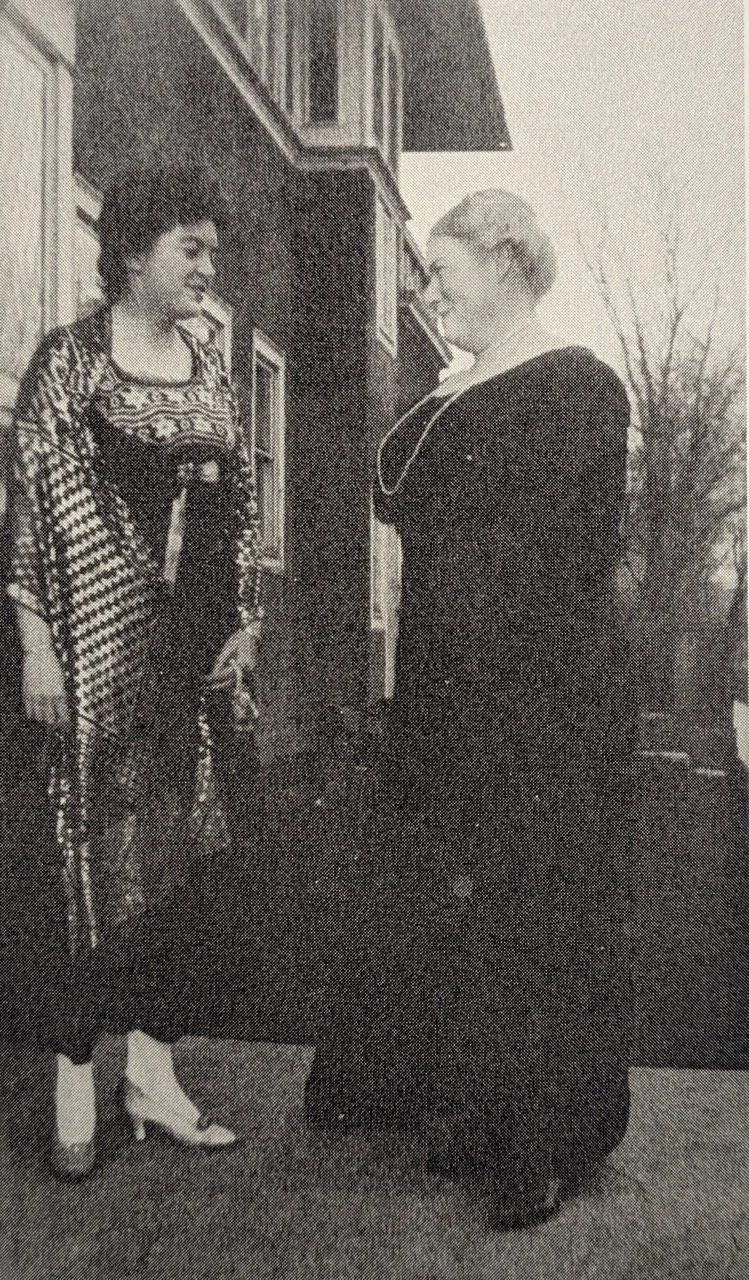
Nevade “Vada” Belle Hemingway visiting with Grace Hall Hemingway in Oak Park, IL in early 1918.
Grace Hall Hemingway was very close to her only sibling, Leicester Hall, and gave her last son her brother’s name—as she had given her first son his maternal grandfather’s name. Their correspondence (in the Hemingway family papers at the University of Texas) documents the mutual sensitivity and concern of Grace and her brother during and after the Spanish influenza period.
Leicester was practicing law in California when he was called for military duty. His wife, Vada, died of influenza on 6 November 1918. On 23 December, he wrote to Grace that he had received her letter of sympathy before he was notified that his wife had died and he did not, at first, understand the subject of which she was talking. On his return to California, he stopped to see Grace and her family in Oak Park. From his letter to her after his return home, it is clear that Leicester had noted a high level of tension in the Hemingway household, and that Grace confided to him some things about its source. In fact, he asks her if his letters to her are opened and read by her alone and invites her to bring the “little children” and come visit him for a few months, offering to pay her fare.
Grace and her youngest son, “little Leicester,” went to California for nearly six months. She enrolled him in kindergarten there and set about bringing to order Leicester’s home, which had been left exactly as it was at Vada’s death. One cannot but feel the poignancy in Grace’s accounts of her daily work: the last laundry Vada had done was lying folded on the dining room table, no cleaning had been done, and her brother had given little attention to his own living conditions.
In the milieu of Leicester’s mourning, Grace also had to cope with daily letters from her husband, Clarence, that are rife with mentions of how tired he is and how badly he needs her presence. The fatigue seems to be mingled with depression, to which he was susceptible, and with anxiety, which was nearly constant throughout his life. His emotional neediness and fatigue may also have been exacerbated by the fact that, although Oak Park had comparatively fewer cases of influenza, the infected were primarily cared for at home—by a public health recommendation—and physicians must have made many house calls. Further, a physician had to accompany every troop train originating in the Chicago area to its induction destination.
An Oak Park man died at the Great Lakes Naval Training Facility, but the regular instructions on the recognition and treatment of influenza can be seen in the Oak Leaves during the summer and fall of 1918. After Grace’s return to Oak Park, Leicester advises his sister:
“I hope your trials are not as great as they have been and that some kind of solution may gradually work out ...”
We will probably never know what the specific points of conflict were between the Hemingways at the time, but in these family papers the drama of filial devotion is framed by the influenza pandemic in these two households half a continent apart. Love in the time of influenza, indeed!
Rose Marie Burwell (1934-2020) is the author of Hemingway: The Postwar Years and the Posthumous Novels (Cambridge U.P., 1996). She served on the Boards of The Hemingway Society and the Hemingway Foundation of Oak Park, and held Fellowships from the National Foundation for the Humanities, the Andrew Mellon Foundation and Princeton University Library. She was an emeritus professor at Northern Illinois University where she taught courses in the English Novel and in Modern American Fiction.
This article was published in the Hemingway Foundation Spring/Summer Dispatch 2008