
Interview with Nancy Sindelar, Part 1
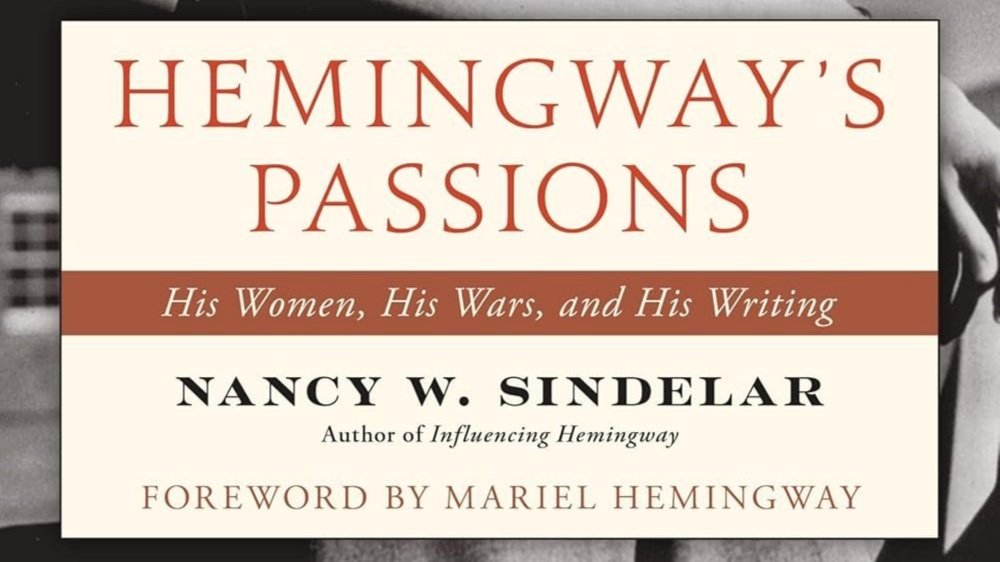
Nancy Sindelar is the author of a new biography, Hemingway's Passions: His Women, His Wars, and His Writing. (Watch a preview here.) Through quotations from his works and personal letters, as well as more than sixty photographs—many of which have not been previously published—Hemingway scholar Sindelar captures Hemingway’s life and adventures, revealing his own feelings about his romantic relationships and the ways his experiences with women appear in his literary works.
By Craig Mindrum
Nancy Sindelar is the author of a new biography, Hemingway's Passions: His Women, His Wars, and His Writing. (Watch a preview here.) Through quotations from his works and personal letters, as well as more than sixty photographs—many of which have not been previously published—Hemingway scholar Sindelar captures Hemingway’s life and adventures, revealing his own feelings about his romantic relationships and the ways his experiences with women appear in his literary works. She is the author of several other books, including Influencing Hemingway: People and Places that Shaped His Life and Work. Nancy also sits on the Board of the Ernest Hemingway Foundation of Oak Park, which oversees the Hemingway Birthplace Museum.
Q: What inspired you to write this book?
Nancy: After Influencing Hemingway was published, I had the opportunity to give a series of book talks. I quickly learned that audiences wanted to know more about the women in Ernest’s life. My subsequent talks on Hemingway’s women were well received and motivated me to research and write a second book that included the details of his relationships with women.
I truly believe writing was Ernest’s greatest passion—it brought him great happiness and also great sadness. Wars, too, were important to him because they allowed him to study men facing dangerous situations—even death. His heroes all exemplified what he called “grace under pressure.” As I drafted the chapters, the title became obvious. Hemingway’s passions were women, wars, and writing.
Q: How does your book address gaps in existing Hemingway biographies?
Nancy: As I researched the women in Ernest’s life, I was amazed at the extent to which they influenced the plot and the characters in his novels and short stories. They all showed up—though not necessarily in a positive light. I believe the examination of his romantic relationships and the influence they had on his writing has not been discussed in previous biographies.
Q: You focus quite a lot on how Hemingway’s real-life interactions—especially with women—ended up appearing in his novels. Can you say something about that?
Nancy: My research revealed insights into the process he used to transform his everyday experiences and relationships into content for his writing. It was fascinating to see how dangerous it was to be Ernest’s friend, lover, or even his wife because you’d show up in one of his novels or short stories.
For example, the character, Brett Ashley in The Sun Also Rises is closely based on a woman in Ernest’s expatriate circle in 1920’s Paris. Lady Duff Twysden was known for her charm and multiple romantic entanglements, and many men, including Ernest and his friend Harold Loeb, pursued Lady Duff. Interestingly, it was Loeb who was apparently successful in that endeavor, and Ernest was jealous and never forgave Loeb. Ernest retaliated by casting Loeb as the character, Robert Cohn. When Brett flirts with other men Cohn acts like a lovesick crybaby, and the expatriate crowd mocks and abuses him. Ernest thus succeeded in giving Loeb cruel fictional immortality though Cohn’s actions and by the utter disdain expressed by the other characters in the novel.
Q: Stepping back in time we find Hemingway, at 19, going off during World War I to be an American Red Cross ambulance driver in Italy. There he is severely wounded and ends up in a hospital, where he meets an important woman in his life, the nurse, Agnes von Kurowsky. How does this relationship affect Hemingway?
Nancy: This was Ernest’s first romantic relationship. He was young, inexperienced and totally taken with her beauty and attentiveness. They didn’t consummate their relationship, but Ernest was confident enough to expect they would marry when they returned home. Later, when he received her Dear John letter, his heart was broken. Agnes, seven years older than Ernest, joined the American Red Cross because she was looking for an adventure and later admitted that she led him on.
Q: But then, as you write in your book, she shows up in Hemingway’s novel, Farewell to Arms, as Catherine Barkley, nurse to the Hemingway stand-in character, Frederic Henry.
Nancy: Yes, here one can really see Hemingway’s creative process—transforming Agnes into Catherine as a kind of wish fulfillment for what he hoped his relationship with Agnes might have been. Though the book doesn’t have a happy ending. Frederic and Catherine have an affair in the hospital, she becomes pregnant, and they run off to Switzerland together. In writing A Farewell to Arms, Ernest followed the advice he later gave to F. Scott Fitzgerald. “When you get the damn hurt, use it.”
Q: Nancy, thank you. On that note, we’ll conclude this part of the interview but will keep exploring Hemingway’s wars and women in upcoming blogs.
Nancy Sindelar, Ph.D., is the author of a new biography, Hemingway's Passions: His Women, His Wars, and His Writing. She is the author of several other books, including Influencing Hemingway: People and Places that Shaped His Life and Work. Nancy sits on the Board of the Ernest Hemingway Foundation of Oak Park, which oversees the Hemingway Birthplace Museum.
Craig Mindrum, Ph.D., is a member of the Board of the Ernest Hemingway Foundation of Oak Park. He received his doctorate in an interdisciplinary field of ethics, theology, and literature from the University of Chicago. He is a writer and business consultant.
FAQs about Ernest Hemingway, American Novelist, Short Story Writer & Journalist
Ernest Hemingway was an American novelist, short story writer and journalist. Our foundation receives numerous inquiries about him and the frequently asked question segment attempts to provide some answers.
Hemingway's Life and Personality
● Who was Ernest Hemingway?
Ernest Hemingway was an iconic American writer known for his sparse writing style and adventurous life. His works, such as "The Old Man and the Sea" and "A Farewell to Arms," delve into themes of courage, loss, and resilience, securing his place in American literature.
● When and where was Ernest Hemingway born?
Ernest Miller Hemingway was born on July 21, 1899, in Oak Park, Illinois. This suburb of Chicago played a foundational role in shaping his early life before he ventured extensively through places like Paris, Spain, and Cuba. You can still visit the Victorian home Hemingway was born in on Oak Park Avenue. Tickets for tours available <purchase>.
● What was Hemingway’s childhood in Oak Park like?
His father, a physician, taught him about the outdoors and to observe nature closely. His mother, a musician and instructor, took him to opera houses and museums in Chicago so he could appreciate the inner life the arts awakened. Hemingway’s family initiated him in the spiritual life of their church where he sang in the choir and reflected on sermons. They were well-off, living in one of the first Oak Park homes to have electricity, and even had a summer home in Michigan.
● Where did Ernest Hemingway live most of his life?
Hemingway lived in Oak Park for 20 years before spending significant parts of his life in various locations including Paris during the 1920s, Key West in the 1930s, Cuba in the late 1930s to the 1950s, and his final years in Ketchum, Idaho.
● Did Hemingway ever work as a journalist?
Yes, after working on the high school paper Ernest Hemingway started his career in journalism as a reporter for the Kansas City Star, where he developed a clear, direct writing style that would become a hallmark of his work. Later, he served as a war correspondent for various newspapers, covering significant events such as the Spanish Civil War and World War II.
● Did Hemingway live in Key West?
Yes, Hemingway lived in Key West, Florida, during the 1930s where he wrote some of his most famous works, including parts of " A Farewell to Arms."
● How old was Ernest Hemingway when he died, and where did he die?
Ernest Hemingway died at the age of 61 on July 2, 1961, in Ketchum, Idaho, from a self-inflicted gunshot wound.
● What's the story behind Hemingway's death? Did he really kill himself after shock treatments?
Hemingway's death was indeed a suicide, following a period of intense depression and numerous electroconvulsive treatments. His mental health struggles were exacerbated by his adventurous yet traumatic life experiences, including plane crashes and war injuries.
● Why did Hemingway join the Red Cross rather than the US Army?
Hemingway joined the Red Cross during World War I as an ambulance driver on the Italian front, partly because he was not old enough to enlist in the army without parental permission, and his eye problems may have also played a role in this decision.
● What did Hemingway do in WWII?
During World War II, Hemingway served as a correspondent and embedded with an army unit to cover combat operations in Europe. He is famous for also liberating the Hotel Ritz in Paris, during the reclaiming of the city by allied troops.
Hemingway's Family and Personal Relationships
● How many wives did Ernest Hemingway have, and who were they?
Hemingway was married four times: to Hadley Richardson, Pauline Pfeiffer, Martha Gellhorn, and Mary Welsh, each relationship reflecting a distinct phase of his life and career.
● Did Hemingway have any kids? Who is Ernest Hemingway's daughter?
Ernest Hemingway had three sons: Jack, Patrick, and Gregory. He did not have any biological daughters, although his son Gregory later transitioned and became known as Gloria.
Hemingway's Work and Influence
● Why was Ernest Hemingway such a big deal? How did he impact American literature?
Hemingway was a monumental figure in American literature, known for his economical and understated style, which he termed the "Iceberg Theory." His narrative technique, focus on universal themes like honor and betrayal, and vivid depictions of human endurance have profoundly influenced modern American writing.
● What did Hemingway write?
Hemingway wrote novels, short stories, non-fiction and journalism. Notable works include "The Sun Also Rises," "For Whom the Bell Tolls," "The Old Man and the Sea," and "A Moveable Feast." A complete list of his works can be viewed <Ernest Hemingway Bibliography>.
● How many books did Ernest Hemingway write? Which book should I read first?
A famed American novelist, Hemingway published ten novels, two non-fiction works, and nine collections of short stories during his lifetime. A good starting point is "The Old Man and the Sea" which won a him a Pulitzer prize in 1953 and a Nobel prize for literature in 1954. "The Sun Also Rises" is also a good option for its quintessential Hemingway style.
● Who and what influenced Ernest Hemingway's writing?
He was significantly influenced by mentors like Sherwood Anderson, Gertrude Stein and Ezra Pound, as well as contemporaries like Mark Twain and F. Scott Fitzgerald. Hemingway’s experiences in Italy in World War I, the Spanish Civil War, and his time in Paris with other expatriates also shaped his thematic choices and stylistic developments.
● What characterizes Hemingway’s writing style? What are the major themes in Ernest Hemingway's novels?
Hemingway's style is characterized by concise, sparse dialogue and a focus on surface elements without explicitly discussing underlying themes, which often explore courage, loss, and the inevitability of death.
Hemingway's Lifestyle and Quirks
● What did Hemingway drink? Was he really an alcoholic?
Known for his love of mojitos and daiquiris, especially during his time in Havana, Hemingway did struggle with alcohol throughout his life, which affected his health and relationships.
● How tall was Ernest Hemingway?
Ernest Hemingway was about 6 feet tall, which added to his larger-than-life public persona.
● Did Hemingway really fight bulls?
Ernest Hemingway was not a professional bullfighter, but he was deeply fascinated by the sport during his time in Spain. He wrote extensively about bullfighting, most notably in his non-fiction work "Death in the Afternoon”.
● Was Hemingway a big game hunter?
Hemingway was indeed an avid big game hunter. He went on numerous hunting safaris in Africa, which greatly influenced his writing in works such as "The Green Hills of Africa" and "The Snows of Kilimanjaro," which depict hunting scenes and explore themes of nature, human endurance, and mortality.
● How many cats did Hemingway have? What's a Hemingway cat?
Hemingway famously had about 50 cats at his home in Cuba. "Hemingway cats," or polydactyl cats, are known for their extra toes and are descendants of Hemingway's original cat, Snow White.
● Was Ernest Hemingway a communist?
Hemingway was not a communist, but he expressed sympathy for the loyalist cause during the Spanish Civil War and was scrutinized during the McCarthy era.
● Was Hemingway a CIA agent?
There is no concrete evidence that Hemingway was a CIA agent, although he was involved in intelligence gathering for the U.S. during World War II.
● Was Ernest Hemingway gay?
There is no substantial evidence that Hemingway was gay. His relationships and writings predominantly reflect heterosexual relationships, although his persona and works occasionally explored varying aspects of masculinity and femininity.